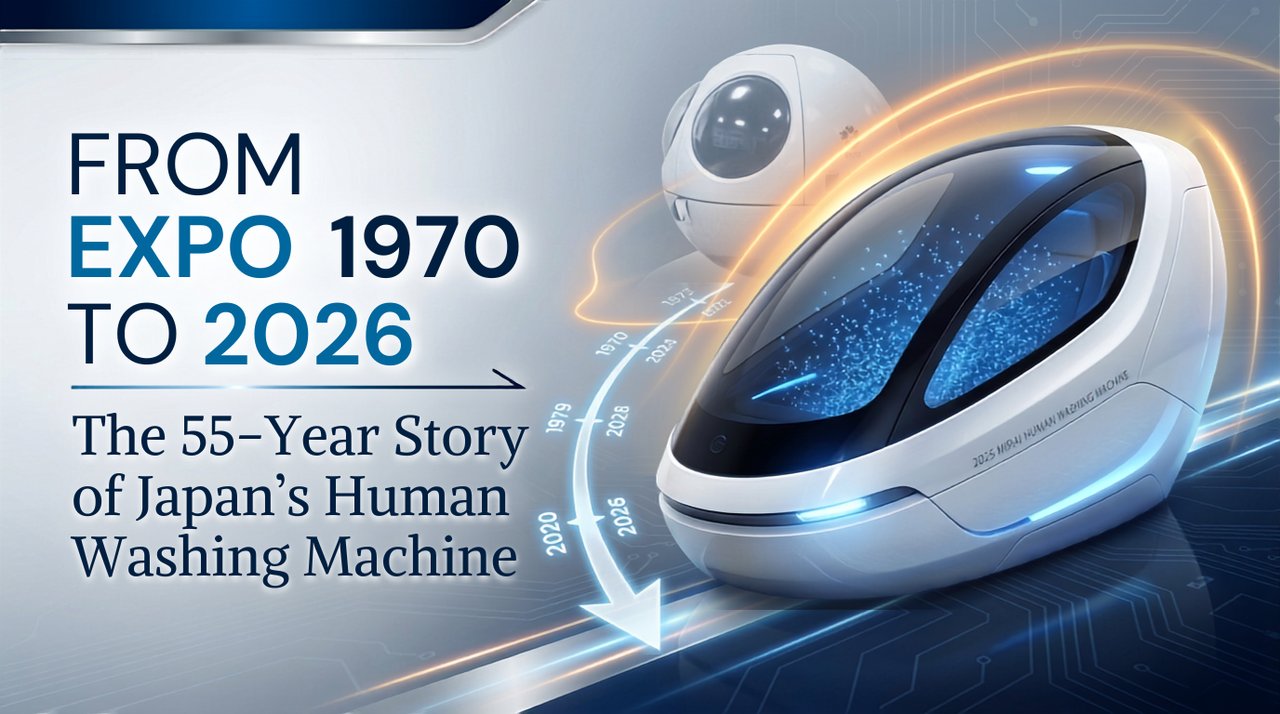
Before the sleek pod of Expo 2025, there was a capsule.
The human washing machine is not a new idea.
It is a 55-year-old Japanese dream, born at Expo 1970 in Osaka and finally realized in 2025.
Here is the full story.
1970 — the origin
Sanyo Electric shows the “Ultrasonic Bath”, a streamlined capsule that bathed you automatically, at Expo ’70 (64 million visitors)
The passion
a 10-year-old boy goes back about 20 times; he later founds Science Co. and revives the idea for Expo 2025
2025 — the reality
reborn as the Mirai Human Washing Machine, with ultra-fine bubbles and biometric sensors
2026 — the legacy
the 1970 original goes to Japan’s National Museum of Nature and Science; the 2025 machine goes on sale, into hotels, and on to its first export to the US
Japan already had one as a vision of the future. At Expo 1970, Sanyo showed an “Ultrasonic Bath” that washed its user automatically. It never became a household product.
1970: the Sanyo “Ultrasonic Bath”
At Expo 1970 — the legendary world’s fair that drew 64 million visitors to Osaka — Sanyo Electric exhibited the “Ultrasonic Bath”.
It was a futuristic streamlined capsule that washed, massaged and dried its occupant automatically, using bubbles made by ultrasonic waves and massage balls.
It never became a household product, but it became one of the most iconic visions of the future ever shown in Japan.
A 10-year-old boy in the queue
A 55-year promise kept by one visitor
In 1970, a 10-year-old boy kept going back to the Expo to see Sanyo’s bathing capsule. About 20 times in six months, he says.
That boy was Yasuaki Aoyama, who went on to found Science Co., the maker of Mirable shower heads.
Fifty-five years later, as its chairman, he brought the idea back for Expo 2025.
It is now on sale, in hotels, and heading overseas.
Among the visitors was a 10-year-old boy. By his own account, he went back to see the machine about 20 times over six months.
That boy, Yasuaki Aoyama, grew up to found Science Co., the Osaka company behind the “Mirable” fine-bubble shower head.
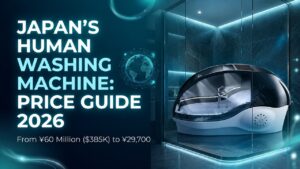
Fifty-five years later, his company built the modern successor for Expo 2025 — the Mirai (Future) Human Washing Machine.
Two machines, 55 years apart
| 1970 “Ultrasonic Bath” | 2025 Mirai Human Washing Machine | |
|---|---|---|
| Maker | Sanyo Electric | Science Co. (Osaka) |
| Shape | Futuristic capsule | Streamlined pod with glass canopy |
| Technology | Ultrasonic waves + massage balls | Ultra-fine bubbles + AI biometric sensors |
| Debut | Expo 1970 (64 million visitors) | Expo 2025 (25.6 million ticketed visitors; 29 million including pass holders) |
| Fate | Never became a household product → donated to the National Museum of Nature and Science (2026) | On sale (¥60 million) → hotels & saunas → exported to the USA |
2026: from museum piece to export product
The two generations of the machine met very different fates — and both made history in 2026:
- The 1970 original, preserved by Panasonic (which absorbed Sanyo), was donated to the National Museum of Nature and Science in Tokyo, according to the Yomiuri Shimbun.
- The 2025 successor went on sale (¥60 million via Yamada Denki), entered hotels and saunas across Japan, and won its first export deal — five units to a US resort.
- A care version followed: the ¥1.45M care model now used in Japanese care facilities.
A dream shown to millions in 1970, kept alive by one visitor for half a century.
Now it is washing real bathers in hotels — and on its way to America.
Want to experience it yourself?
\ Experience the 55-year dream in Tokyo, Osaka and Hokkaido /
\ From the ¥60 million pod to ¥29,700 shower heads /
Based on official announcements, museum reports and Japanese media coverage. 日本語版はこちら(Japanese version)
📢 Updates on X → @kurochan_de
👉 And 55 years later, what does it cost? Every model and its 2026 price, from ¥29,700 to ¥60 million