Japan is the world’s most aged society — nearly 30% of the population is over 65.
Bathing is central to Japanese care culture.
That combination has made Japan a quiet leader in assisted-bathing technology.
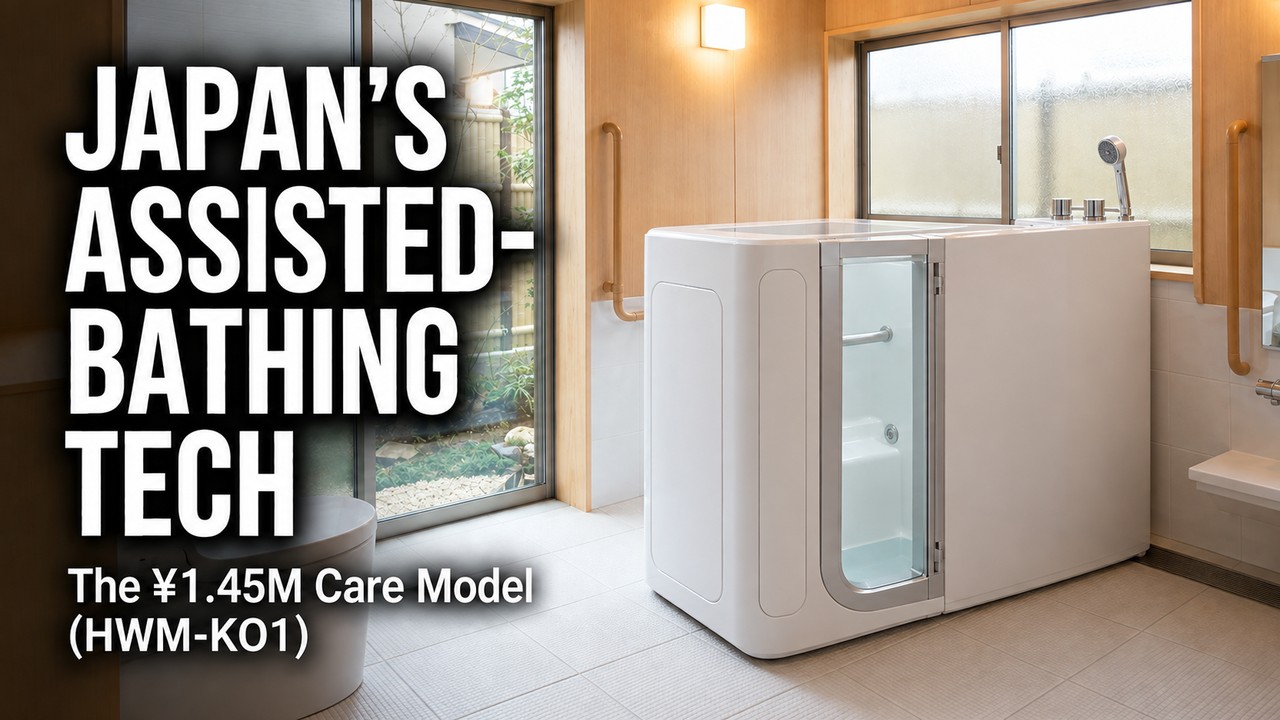
The latest example is the care model of the famous “Human Washing Machine”.
It is drawing new attention as the full machine starts being exported to the US.
The problem it targets
helping a resident step over the tub rim — the moment that strains caregivers’ backs and when falls happen
Compact design (HWM-KO1)
walk-in door-type tub, fine-bubble shower with no soap needed, 1,240 × 650 × 990 mm
No special wiring
runs on a standard outlet (AC 100V / 500W)
Subsidy in Japan
bathing-support equipment is covered by the FY2026 care-technology subsidy — a single device is capped at ¥1 million, and each prefecture sets the rate (four-fifths in Miyagi and Chiba in FY2026; package purchases have higher caps)
The key to easier bathing care is removing the step over the tub rim. That transfer is where backs get strained and where falls happen.
The problem: bathing is the hardest part of care work
In Japanese care facilities, bath assistance is one of the biggest physical burdens on staff.
The critical moment is the transfer — helping a resident step over the tub rim.
It strains caregivers’ backs, and it is when falls happen.
With chronic staff shortages, technology that removes this step matters.

How much would something like that actually cost a care home?
人間洗濯機
編集部
The care model costs ¥1,450,000 plus tax.
The details are in the table below.
The answer: a ¥1.45 million walk-in care model
Science Co. — maker of the Expo 2025 “Human Washing Machine” — redesigned its technology for care settings.
It co-developed the compact care model (HWM-KO1) with SOYOKAZE, one of Japan’s largest short-stay care operators, and tested it in real facilities.
The model was announced in December 2025, and shipments started in March 2026.
| Product name | Mirable Assist Bath (the maker’s current name for the care model; L and R types) — official product page |
|---|---|
| Price | ¥1,450,000 + tax (≈ US$9,000–10,000) |
| Key design | Door-type tub — no stepping over the rim; residents walk in |
| Cleansing | Microbubbles, no soap needed; face and hair washed with a fine-bubble hand shower |
| Size / weight | 1,240 × 650 × 990 mm, ≈100 kg — fits existing bathrooms |
| Power | AC 100V / 500W — a standard household outlet, no special wiring |
| Water | ≈160 L pre-stored per session |
The design philosophy is telling.
Rather than a ¥60 million showpiece, this is a strategic price point — comparable to a bathroom renovation — so ordinary care facilities can actually buy it.
Japan’s government supports the shift too, through a subsidy for care technology:
Why this matters outside Japan
- Every developed country is aging — the caregiver-burden problem Japan faces today arrives everywhere tomorrow.
- The technology has started traveling: the full model’s first export (five units to a Georgia resort, USA) was reported to ship in stages from spring 2026.
- Soap-free fine-bubble cleansing means there is no soap or shampoo to lather and rinse off — one less step in assisted bathing, anywhere.
Curious to see the technology yourself?
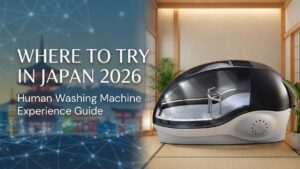
The full “Human Washing Machine” can be experienced at hotels and stores in Japan — see our 2026 experience guide below.
\ 介護施設の方へ:入浴担当者への取材と、導入の実務(日本語) /
\ Want to see the full machine in Japan? /
Based on official announcements by Science Co. and Japanese media reports. Specifications and subsidy conditions may change. 日本語版(施設向け実務ガイド)はこちら
📢 Updates on X → @kurochan_de
👉 How does the ¥1.45M care model compare with the rest? All models and prices, side by side